
A ray of hope from abroad
Dear readers,
Today I want to share a glimpse of the success of a doctor in France whose work in integrative oncology I have admired for years, Dr. Jean-Lionel Bagot. Recently I saw a presentation he made with Dr Ingrid Theunissen and I was struck once again by the excellent model of care Dr. Bagot provides, and by the results. I also realized once again that almost no one in North America is aware of such care being offered in other parts of the world. If you find the information below as interesting as I do, please share it!
At an integrative clinic surrounded by green space, people with cancer have access to acupuncture, lifestyle medicine, nutrition, homeopathy, and numerous other options alongside their conventional medical treatments. In this model, a balance is sought between conventional medicine, complementary medicine, and self-care. In a survey of 535 patients in Strasbourg, 47% were using complementary therapies and 97% were satisfied with the results of their complementary care. Other studies suggest the number of patients using complementary medicines during cancer treatment is around 60%, with homeopathy being the most commonly chosen modality in France.
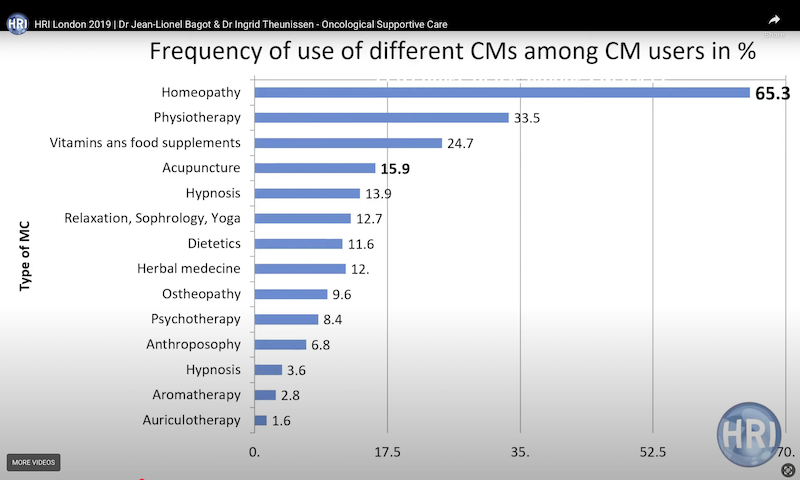
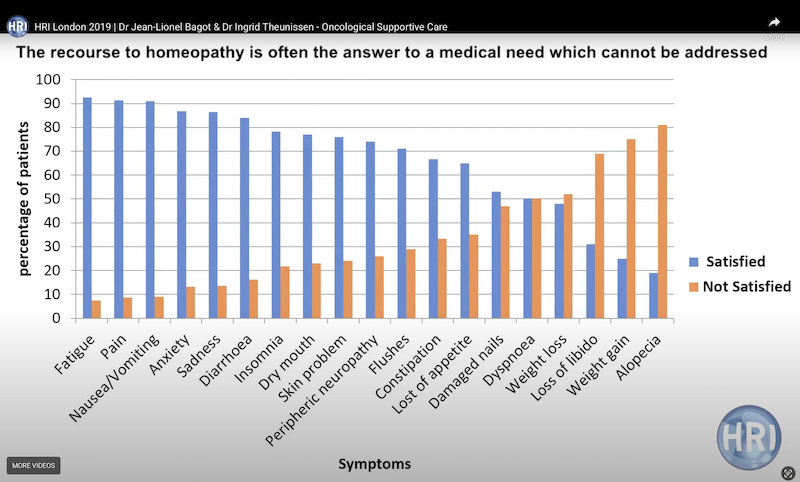
Working with classical homeopathy, Dr. Bagot and colleagues achieve results which are both eye-opening and heart-warming. As you can see in the graph below, some of the adverse effects of conventional treatment which oncologists have no way to address are managed beautifully by individualized homeopathic care. One example reviewed in the presentation is thrombocytopenia, the loss of platelets in the blood, a common and dangerous side effect. Homeopathic treatment has reversed this condition, avoiding the need for transfusions. Nausea, pain, fatigue, dry mouth, emotional distress, and many other symptoms have been relieved. The graph below shows the success of homeopathic treatment in countering some of the most common and debilitating effects cancer patients suffer.
Homeopathy is one of the most used complementary medicines worldwide, with very high rates of patient/client satisfaction. A fascinating aspect of Dr. Bagot’s research is that in France, 82% of patients using homeopathy do so with the knowledge and support of their oncologist, while only 20% in the United States disclose their use of homeopathic medicines to their doctors. Cooperation and dialogue between medical doctors, complementary and alternative practitioners, and patients benefit everyone, and patients most of all.
For those unfamiliar with homeopathy, it’s a 230 year old medical system set in motion by a German medical doctor, and in most countries is still practiced only by medical doctors. It uses high-dilution medicines made from natural substances (most often plants and minerals) through a unique and rigorous process. Homeopathy is an excellent candidate for supportive care because it does not interact chemically with other medications. It is simple to use, totally non-invasive, and if prescribed properly is virtually free of side effects.
For some reason, in the English-speaking countries homeopathy is viewed with prejudice, suspicion, and scorn by most doctors. Mainstream media perpetuate the myth that it doesn’t have scientific evidence behind it, which is simply untrue. This is immensely unfortunate, because as you can see it has much to offer, whether in the complementary setting or as a gentle but potent healthcare choice for many conditions. The criticism comes from people who have not taken the trouble to understand what homeopathy is and choose to ignore the millions of their near neighbors, right here in North America, who use and appreciate it.
While integrative care models continue to become more available in other parts of the world, the vast majority of people who face a cancer diagnosis in the US or Canada have no such luck. Complementary care is rarely suggested by medical providers, and if one does insist on it, it must be found and paid for out-of-pocket—prohibitively, or destructively, expensive for many. The great majority actually feel they have to hide it from their oncology team.
With a wealth of research and clinical trials worldwide showing its many benefits, why is supportive and complementary treatment so hard to come by in North America? And how can this be changed? How can these urgent questions take the central place they deserve in public dialogue about healthcare? In this era of information and communication, it’s up to us spread the word about humane, effective, patient-centered medicine.
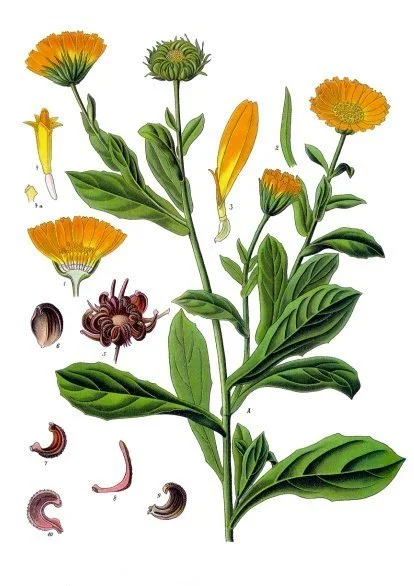
Graphs used by the kind permission of Dr. Jean-Lionel Bagot. Calendula officinalis illustration by Franz Eugen Köhler, Köhler-s Medizinal-Pflanzen-024, public domain.