Ninety-nine percent inert? I don’t think so.
We have all heard it: our bodies are largely made of water. Some say we’re sixty percent water by volume, some say more. But here’s another light on the situation: more than 99% of our molecules are water molecules.
Although in some ways biology and medicine have become extremely sophisticated, there are indications that crucial pieces are missing in our comprehension of life on Earth. Water has been assumed to be a necessary but neutral backdrop against which biological processes occur. The water within us—the water which is most of what we are—is considered to have no active functions but to be a simple solvent, an inert substrate.
But some have questioned this all along. In the modern sciences, we can find protests here and there over the past two hundred years. Surely this material which is indispensable for every living cell on Earth is playing an active part in life’s processes—even if it isn’t immediately obvious to us what that part is. In Nature there is no such thing as a waste product, there is nothing which does not have a use in the greater system. And in a very real and immediate sense water is the system. In the understanding of the vast majority of humanity over our entire history, water is an ever-active, archetypal, natural force.
In science, the many fascinating and mysterious properties and behaviors of water have been simply ignored, as if we know all we need to know and can concern ourselves with more important questions. But far from being so simple and so thoroughly known that we don’t need to bother about it (even as we declare "without water no life would be possible!”) water has remained a ubiquitous yet subtle and enigmatic aspect of our world.
A few commonplace examples:
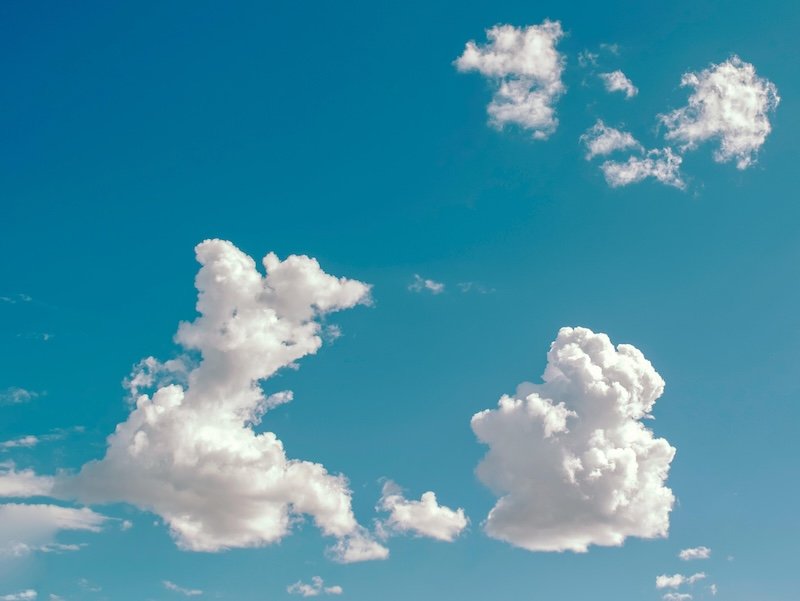
Imagine you are standing on a beach. The sea is calm and the sky is blue, except for one nice fluffy cloud. The cloud is made of water vapor, which has risen from the ocean. So far, so good. But the vapor rises equally from the surface of the water; why isn’t it evenly distributed in the sky? What causes it to come together and stay together, forming a cloud? Furthermore, why does that cloud stay suspended in the air? Water is heavy. According to data from NASA, our ordinary little white cloud hanging peacefully above the sea might weigh well over a million pounds. If you ask the internet for an answer to this, you’ll see something about warm air rising under the cloud keeping it elevated. Which is all very well… except that often there isn’t warm air rising under clouds. And it remains to be explained why the cloud exists at all.
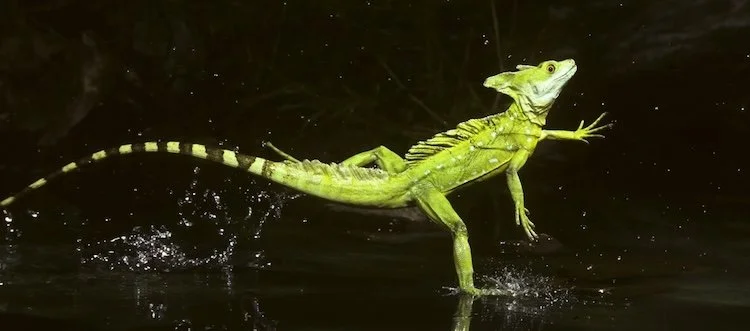
Another strange phenomenon is lizards which can walk on the surface of standing water. When we ask how, the automatic answer (as is often the case with water questions) is “surface tension.” But the surface tension of water involves the top one or two layers of molecules. So a tiny mosquito, maybe… but the lizards in question can weigh as much as a pound. When scientists got around to doing the math, it was immediately obvious that this explanation doesn’t work at all.
A naturalist in Germany named Schauberger seems to have been the first to observe, ponder, and document, back in the 1800s, that when water moves through a tube it does not travel in a straight line. Instead, it spirals. Think of water running down the bathtub drain; it doesn’t simply fall down into the hole, it creates a vortex. Why doesn’t it just fall? Decades later, medical researchers began to notice the same spiralling of blood along the inner surfaces of human blood vessels. This is now a well known an accepted phenomenon known as helical flow.
The existence of helical flow becomes even more interesting when we consider research showing that the pumping action of the heart can’t be the only force moving blood through the circulatory system. It simply isn’t sufficient, given the minuscule proportions of the capillary system. Red blood cells move through around 60,000 miles of blood vessels. Tens of thousands of miles of capillaries must keep your cells oxygenated, nourished, and cleansed, and many have a diameter smaller than the width of one red blood cell. (One of the reasons a chronic inflammatory condition like diabetes is so damaging is that the small vessels become rigid and can’t allow blood cells to pass through.) Some more finely-tuned mechanism than one massive muscular pump in the chest appears to govern at the capillary level, where a very gentle and steady propulsion system is required.
Water researchers who left a piece of tubing submerged in water accidentally discovered that although the water was at rest, the tubing was at rest, and no force of any kind was introduced, something caused water to continually flow through the tube. It was as if the inner walls of the tube were gently pulling the water through—in a helical pattern. This phenomenon was confirmed… just think how ordinary and common such a situation is in nature, and unnoticed by us! But now studies have substantiated the idea that the movement of blood through our circulatory system is partly accomplished through a complex interactive process of the vessels and the blood itself.
It turns out that water’s peculiar characteristics mostly have to do with electrical charge. How this actually works, how so much energy is present that, for example, the surface of a pond can withstand the weight of the lizard or a million pounds of water can float in the sky, is just now emerging. The implications are beyond imagining, for science, for medicine, for technology and industry, for agriculture, etc., etc.
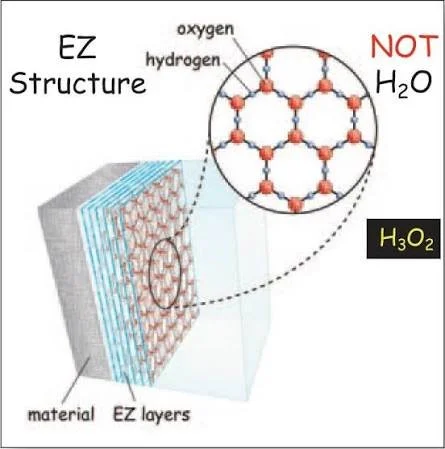
A water molecule is dipolar; we learned that much in high school. The molecule has a negatively charged region and a positively charged region. Researchers have accumulated a strong body of evidence showing that when in contact with most surfaces, water molecules align themselves in a highly organized state which they often refer to as a liquid crystal. In this state, known as the “fourth phase” of water, individual molecules relinquish their structure, rearranging to form not two hydrogen atoms and one oxygen, but three hydrogen and two oxygen. This allows the molecules to form a perfectly regular, stable, hexagonal structure—considered the strongest and most efficient of Nature’s forms. Layer upon layer of this structure builds, with millions of molecular layers being common in the natural world. A video below demonstrates the strength of fourth-phase water; liquid water could do nothing of the kind.
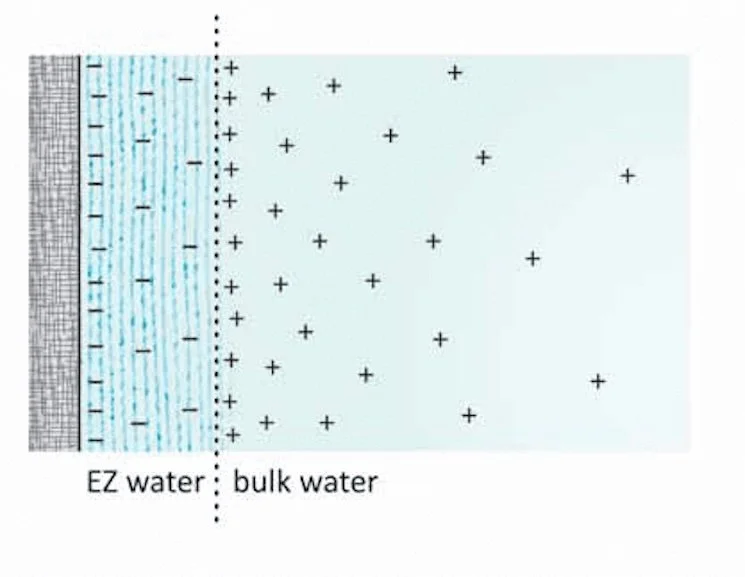
A separation of negative and positive charges in this arrangement stores energy. We are all familiar with storing energy by separating charges. We call it a battery. And it can’t help but change our understanding of biology from the ground up when we realize that most water in living cells, as well as much of the water found in the natural world, is not in the form of ice, vapor, or liquid but in the fourth state. Against a hydrophilic surface, a region of negative charge collects. Water scientists call it the “exclusion zone” because any dissolved substances are expelled, pushed out into the positive zone, to allow the extremely stable, gel-like structure of fourth-phase water.
Obviously there is far more to say about this topic than I can share in this brief article. However I’ll throw in one more piece. The energy source for all this organization was also discovered by accident. Yes, rearranging all these molecules and building exclusion zone (or “EZ”) water requires energy; and EZ water in turn is capable of storing energy as well as information (more on that another day). The primary driver of this process, as far as we have seen so far, is light. Infrared light in particular. And that’s fascinating for many reasons, but I’ll mention just one here: it turns out that this mechanism is familiar to us from the world of plants. Photons of light fuelling the production of energy through separating water molecules into negatively and positively charged zones—this is the first stage of photosynthesis, and it now appears that our cells are doing the very same. Our cells quite literally make energy from light, even light that is not visible to human eyes.
If you have found this interesting, watch for Part Two in which I’ll follow the emerging science of water into some critical implications for our health and healing.